
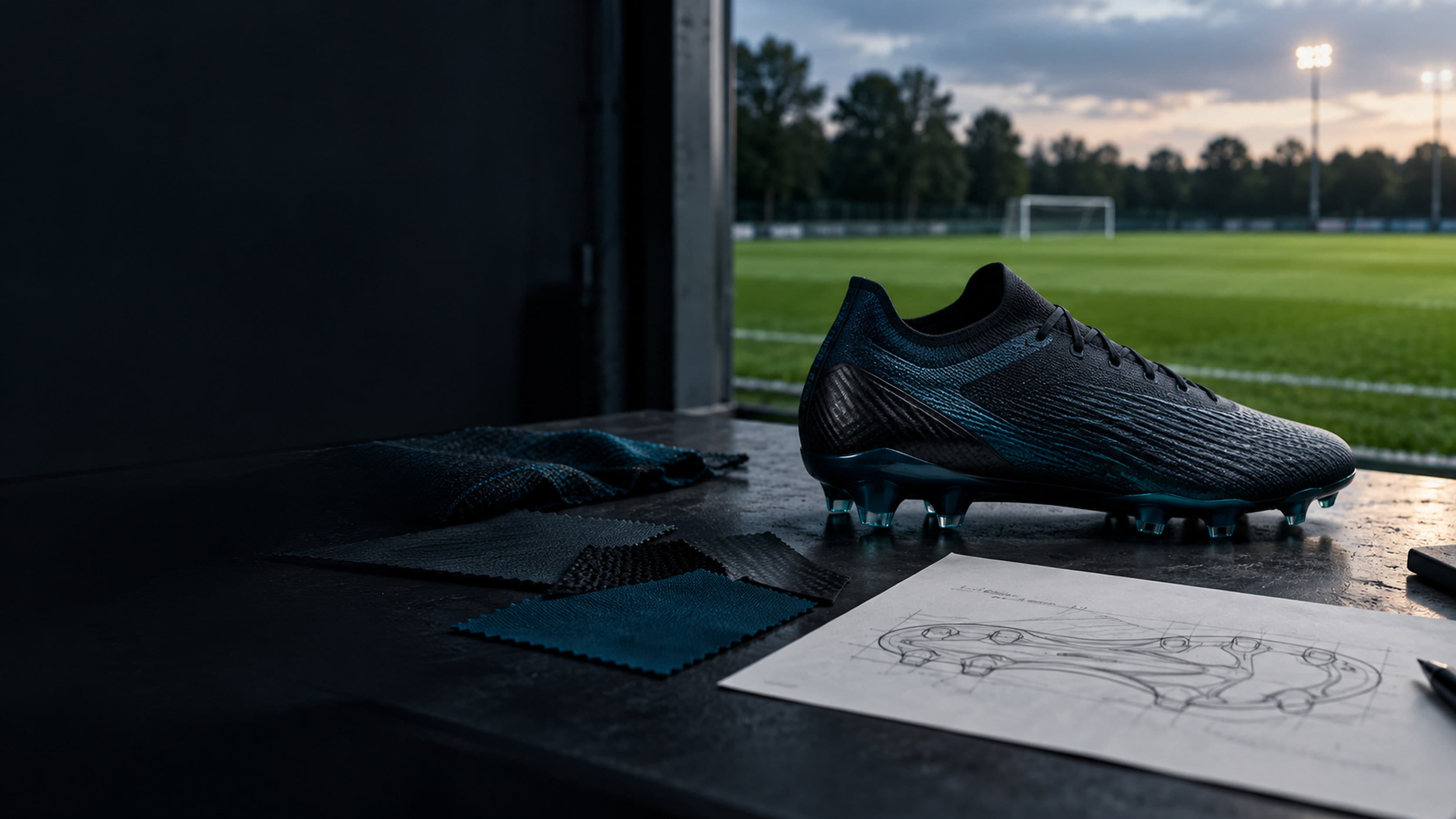

Lab quality on the real pitch.
Test prototypes, stud designs and outsoles where they will have to perform – reproducibly and with realistic biomechanics.
Real playing surfaces don't fit in a lab.
Stationary research rigs reproduce biomechanics in detail but work with surface samples in the lab. Mobile field devices are easy to use but rely on simplified test devices without a lower-leg axis, whose joint position is fixed or adjustable only in steps. For traction questions – often until late in development – manufacturers therefore frequently depend on external research institutions. Our test rig combines both: realistic biomechanics on real playing surfaces. And because it can also be operated in a stationary setup, you work with the same system in the lab and in the field, with directly comparable data.
Stationary research rigs
- BiomechanicsModelled in detail
- Playing surfaceSoil samples in the lab only
- DeploymentStationary only
Mobile field devices
- BiomechanicsSimplified test bodies
- Playing surfaceReal playing surface
- DeploymentMobile
TraqSafe test rig
- BiomechanicsRealistic, with an adjustable lower-leg axis
- Playing surfaceReal playing surface
- DeploymentMobile and stationary
Realistic biomechanics, deployed in the field
Continuously adjustable tibia axis
The orientation of the lower leg is set by software – quickly, reproducibly and without mechanical reconfiguration.
Adjustable ankle and flexible foot model
Joint position and foot model realistically reproduce the loading inside the boot.
Translational and rotational load cases
Tests that correspond to real movements – including load cases that cannot be imposed on human test subjects.
Forces and moments
The forces and moments between boot and ground are captured together with the conditions of each measurement.
Mobile and battery-powered
Measurements take place on real playing surfaces instead of soil samples. Stationary lab operation is also available on request.
Adjustment ranges, load limits and further technical data are available in a personal conversation.
What manufacturers can use the test rig for
Prototype testing
Evaluate prototypes early and under realistic conditions on real playing surfaces.
Stud design and outsole materials
Test variants against each other in a targeted, reproducible way.
Product comparisons
Compare models, generations and configurations under identical load cases.
Load capacity
Test the compliance and load capacity of boot and outsole constructions – including beyond what is possible with human test subjects.
Analyses built for R&D
Traqometry gives every customer segment the right view of the data. For manufacturers, that means in-depth technical analyses and comparisons, traceable results and a data basis that stays comparable across generations of prototypes. When the analysis methodology evolves, earlier measurements can be re-evaluated – without measuring again.
Re-analyse earlier measurements without measuring again
Your prototypes stay confidential.
Prototype measurements are trade secrets – and Traqometry treats them that way. Your data is stored in the EU, encrypted per customer and strictly separated from other customers' data. It never leaves your account.
- Stored in the EU
- Customer-specific keys
- Strictly separated from other customers

From research, for development
Our test rig is backed by almost two decades of traction research at the Technical University of Munich. Founder Karlo Condic researched the interaction between boot and ground there, in projects with partners from professional football and the sports footwear industry. With the test rig, we have translated this experience into an independent system, designed for use in product development. The prototype is currently being built; validation and first pilot projects follow in 2027.
- Based on the TUM TracTester
- Patents pending
- Pilot projects from 2027
Let's discuss the technical details in person.
Tell us which questions your development team is working on – and we will show you how our test rig can contribute. Under NDA if you prefer.